Latin America in Regent’s Park
At Frieze London and Frieze Masters, some of the week’s most persuasive work came from much further south, and a Colombian master entered the Tate.
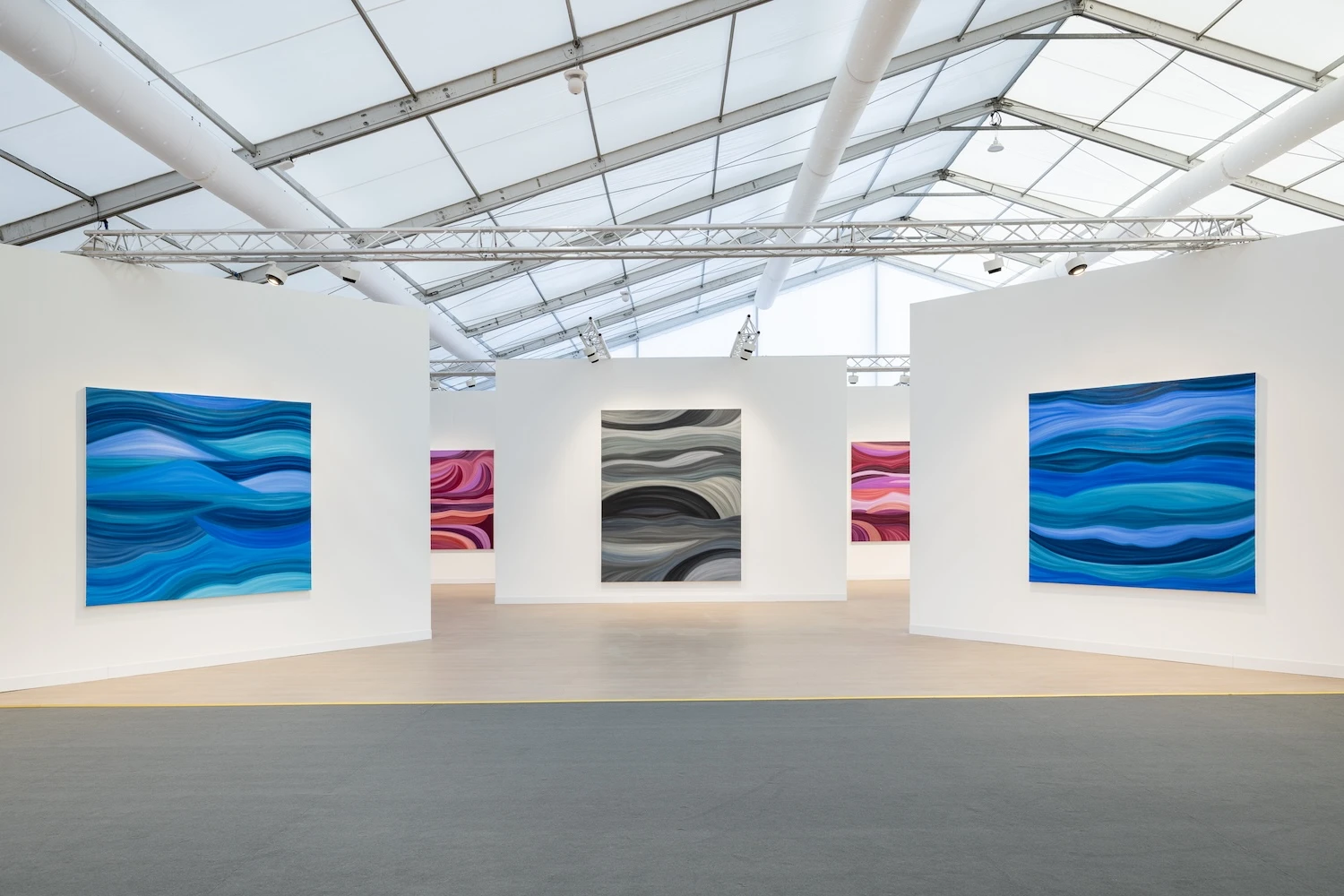
Marina Perez Simão at Frieze London, Pace Gallery. Photo: Damian Griffiths. Courtesy Pace Gallery.
Every October, London asks the art world to look at it. For five days, two white tents in Regent’s Park hold more than three hundred galleries between them: Frieze London for the art of now, Frieze Masters for everything that came before. Collectors fly in from New York, Seoul and São Paulo, the city’s museums open their autumn shows, and the auction houses schedule their sales around the fair. For one week, it is the centre of the calendar.
This year, the week opened as these weeks usually do, with a headline number. At Frieze Masters, a flower still life painted by Jan Brueghel the Elder around 1607 was placed at roughly £5 million. Across the park, a booth of six new paintings by Albert Oehlen sold entirely, each above a million dollars. Four centuries apart, the two sales framed the fair neatly. But the more telling story was in the quieter rooms.
A market that buys, slowly
The mood on the floor was steady rather than euphoric. Galleries sold well across price points, and much of the early activity sat below £50,000, where new collectors tend to begin. Dealers spoke of a market that is buying again, but taking its time. Decisions that once happened over a single preview morning now stretch across days.
That pace changed what worked. Focused presentations, often a single artist with room to breathe, did better than crowded booths. A slower market rewards work that asks for attention, and several of the week’s most attentive rooms belonged to artists from Latin America.
A fair suited for solo presentations.
Zapata enters the Tate
The week’s most meaningful acquisition, for us, happened at Frieze Masters. Tate acquired Barge (1992) by the Colombian artist Luis Fernando Zapata (1951–1994) for its national collection, through the Frieze Tate Fund. It is the first work by Zapata to enter the Tate collection.
The work was presented by Galería Elvira Moreno, the gallery we work with at Front Row, together with Alonso Garcés Galería, in a booth titled An Archaeology of Ephemerality. Barge stands nearly two metres tall, made of natural pigments on hand-moulded papier-mâché: a vessel built from one of the most fragile materials an artist can choose, now held by one of the world’s great museums.
The booth was part of Queering Modernism, a new curated section at Frieze Masters led by Anke Kempkes, which looks at how gender and sexuality shaped twentieth-century art. Zapata made much of his late work as he faced his own mortality, and his papier-mâché pieces carry that awareness: light objects shaped like monuments, memorials made by the person they remember. In the same section, three paintings by Alice Neel sold for a combined $5 million. Zapata’s place in that conversation is part of a larger correction, as Frieze Masters makes room for the histories the canon left out.
Since Frieze London began in 2003, Tate has acquired more than 180 works through the fund. For a Colombian artist who died in 1994, and for the galleries that kept his work in view, joining that collection is a milestone.
Brazil, in colour
At Frieze London, Brazilian painters set much of the tone. Dalton Paula, presented by Lisson, paints portraits that restore presence to Black historical figures overlooked between the sixteenth and nineteenth centuries. The works are quiet, frontal and dignified, and they hold a booth without needing scale.
At Pace, Marina Perez Simão showed landscapes built from light and water, abstract enough to feel like weather, specific enough to feel like a place. Nearly all of them sold on the first day. São Paulo’s Fortes D’Aloia & Gabriel was among the galleries that closed the opening day with a sold-out booth. Together, they showed how far Brazilian painting has travelled from being a regional category.
Mendieta, twice
Ana Mendieta, who left Cuba as a child and became one of the defining artists of her generation, was present twice this week. At the fair, her 1972 photographs show her with a friend’s beard glued to her own face, a direct, fearless question about how gender is worn. Across the city, Tate Modern is giving her a major retrospective. For a Miami audience, her story carries particular weight: a body of work shaped by displacement, memory and the body, as urgent now as it was fifty years ago.
Beyond the tents
Frieze has always been more than its booths. This year’s Frieze London Artist Award went to Theo Triantafyllidis, whose commission, Feral Metaverse (Spider), is a giant sculpture visitors climb onto to play a multiplayer game together. Elsewhere in the city, Tate Britain’s exhibition on art and fashion in the 1990s traced how closely the two worlds moved in that decade, a dialogue we follow closely at Front Row.
From London to Miami
Frieze closed on Sunday, and the calendar now turns towards December and Art Basel Miami Beach, which arrives smaller, sharper and with a strong Latin American presence of its own. If London is any guide, collectors will come ready to buy, but they will want to look first.
That suits us. Latin American art is no longer a discovery at these fairs. It is part of the main conversation. At Front Row, it has been our conversation from the start.